










Study in the UK

HomeStudy in the UK
Students working in a science laboratory and in a computer classroom
Why Study in the UK?

World-class learning with practical ambition

World-class universities with respected academic standards, teaching methods built around practical, applied learning, and qualifications employers recognise well beyond Britain's borders. Over 90% of UK degree students finish the course they started, the highest completion rate of any major study destination.

Find Your Pathway

Your Qualification Already Tells Us Where to Start

Your qualification already tells us most of what we need to know. Find your row below, and treat the typical route as a starting point for the free consultation, not a final answer; exact eligibility always depends on grades, institution, and course.

Your Current QualificationWhat You Can StudyTypical Route
Senior Secondary / High SchoolFoundation Programme1-year Foundation + 3-year Bachelor's
A-Levels, IB, or equivalentBachelor's Degree, direct entry3-year Bachelor's (4 in Scotland)
Diploma / HND (or equivalent)Top-up Bachelor's Degree1–2 year top-up into final year(s)
Bachelor's DegreeMaster's Degree1-year Master's
Bachelor's Degree + relevant work experienceMBA1-year MBA
Master's DegreePhD / Doctorate3–4 years
Foundation Programme1-year Foundation + 3-year Bachelor's
Guidance only: This table shows the general route, not a guarantee, in line with the British Council's National Code of Ethical Practice. We welcome enquiries from students from all countries and educational backgrounds. Eligibility is assessed individually based on your academic qualifications, English language proficiency, and the entry requirements of your chosen university and course.
Your 12-Month Journey

A Clear Countdown to Your UK Intake

Starting later than eight months is often still possible, especially for a January intake. These timings are recommendations, not hard cut-offs.

  1. Month 12–10

    Free Consultation & Pathway Assessment

    We review your qualifications, budget, and goals, and confirm your route using the Pathway Finder.

  2. Month 10–8

    Course & University Shortlist

    A shortlist of UK institutions that genuinely fit your profile, not the biggest names, the best fit.

  3. Month 8–6

    Application Submitted

    Documents, personal statement guidance, and submission, handled with you, not just explained to you.

  4. Month 6–4

    Offer & CAS

    Understanding your offer and Confirmation of Acceptance for Studies (CAS), the document your visa application depends on.

  5. Month 4–2

    Visa Application

    Document checklist, proof-of-funds guidance, and application timing support.

  6. Month 2–0

    Pre-Departure Preparation

    Accommodation, banking, flights, and what to actually expect in your first two weeks.

  7. Month 0

    Arrival & Orientation

    You land. We're still reachable, this isn't where the relationship ends.

Academic Pathways

Popular study levels and in-demand course choices

Popular Study Levels
Foundation ProgrammesBachelor's DegreesMaster's DegreesMBA Programmes
Popular Courses
Business and Management
Accounting and Finance
Computer Science
Artificial Intelligence
Engineering
Law
Psychology
Healthcare
Marketing
Human Resource Management

Plan Your UK Studies with Confidence

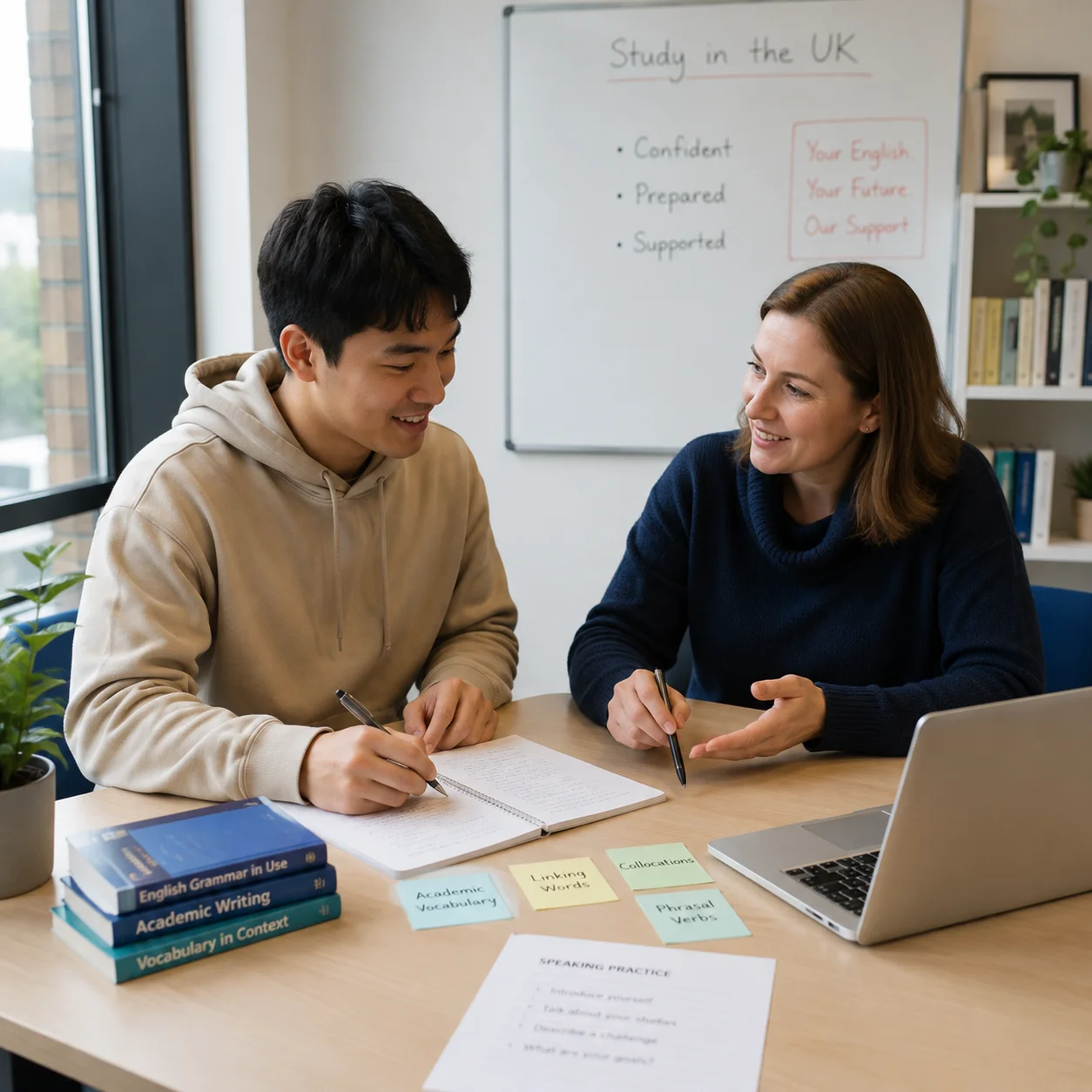
A student and an adviser working through English language practice materials together
English language support

Your English Level, Supported, Not a Barrier

Most UK courses require proof of English proficiency, typically through IELTS or an approved equivalent, but many applicants qualify for an exemption if their secondary and/or tertiary education was taught and assessed in English. We check this during the free consultation, before recommending any test.

Where a test is genuinely required, we help identify which test a student's target institutions accept, what score their specific course actually requires, and build a realistic preparation timeline into the wider 12-month journey, so English preparation becomes one clearly scoped task, not an open-ended worry.


A student reviewing a budget and receipts in shared accommodation
Planning your finances

Cost of Studying in the UK

Because UK degrees run shorter than in many competing destinations, three years for a Bachelor's, one year for most Master's, total tuition and living costs are frequently lower overall, even where the annual tuition figure looks comparable to a longer programme elsewhere. Living costs vary by city, with London noticeably higher than the rest of the country.

A student organising a passport and UK visa application documents
Visa preparation

Student Visa, What to Expect

Most students apply for a Student visa through UK Visas and Immigration. At a high level, that means holding an unconditional offer and a Confirmation of Acceptance for Studies (CAS) from a licensed UK sponsor institution, demonstrating English language ability (or a confirmed exemption), and showing proof of funds sufficient to cover tuition and living costs, held for a minimum of twenty-eight days before applying. Applicants aged sixteen or seventeen also need evidence of parental consent. We provide guidance and document checklists throughout; the decision itself always rests solely with UK Visas and Immigration.

Students cooking and washing up together in a shared UK accommodation kitchen
Student Life in the UK

A social, cultural, and international experience

Life in the UK extends well beyond lecture halls: student societies covering nearly every interest, the right to work part-time during term and full-time in the holidays, affordable travel across continental Europe, and, on most campuses, an established, welcoming student community.

Support Throughout Your Journey

Guidance that continues beyond the application

From university selection to pre-departure preparation, our team remains available throughout your educational journey.